
Traces of Thought in Liquid Form
The timeless intimacy between fountain pens, craftsmanship, and the enduring human desire to leave a mark that outlasts the moment
The Gesture That Shaped Thought
There is something ceremonial in the act of writing with a fountain pen. It begins with a pause, a weight of silence before ink touches paper. The gesture itself is deliberate, a collaboration between mind and material. Unlike digital tools that translate thought into pixels, a fountain pen carries the whisper of the hand. The nib reacts to pressure, speed, and rhythm, producing a line that reveals temperament as much as technique. Each word flows in continuity with the writer’s breath, forming not just sentences but evidence of presence. To write in this way is to reintroduce humanity to the written word, to remember that meaning was once crafted rather than typed.
Before the modern pen became a disposable object, writing was a ritual. The fountain pen preserves that ritual by bridging utility and art. It transforms writing from communication into expression, from habit into reflection. The motion of filling the reservoir, the faint scent of ink, the texture of metal and resin, all turn the act into a dialogue between self and substance. Each pen becomes an extension of the person who uses it, storing traces of emotion, memory, and imagination. The ink that flows from it becomes a portrait not of what is written but of how it is written. In this subtle dialogue lies the true charm of fountain pens.
Origins in Metal and Imagination
The story of the fountain pen begins with human impatience. Quills dried too quickly, dip pens dripped excessively, and early inventors dreamed of a self-contained reservoir of ink. By the nineteenth century, these dreams took shape through a series of experiments in pressure and flow. Early designs were clumsy and temperamental, but each failure refined understanding. The fountain pen as we know it emerged through persistence, a triumph of balance between physics and artistry. When Lewis Waterman patented his feed system in 1884, he did more than solve a mechanical problem. He changed how the world communicated. For the first time, ink flowed as smoothly as thought.
These early pens were not merely tools but marvels of engineering. Manufacturers treated them as luxury instruments, crafting bodies from ebonite, gold, and celluloid. Each model carried identity, a statement of elegance and intellect. The fountain pen became synonymous with scholarship, diplomacy, and creativity. To sign a document with one was to participate in a legacy of refinement. As decades passed, styles diversified, some industrial, others ornate, but the essence remained constant. The fountain pen embodied craftsmanship’s marriage with intellect, a fusion of beauty and function that reflected both human ingenuity and aesthetic sensibility.
The Anatomy of Flow
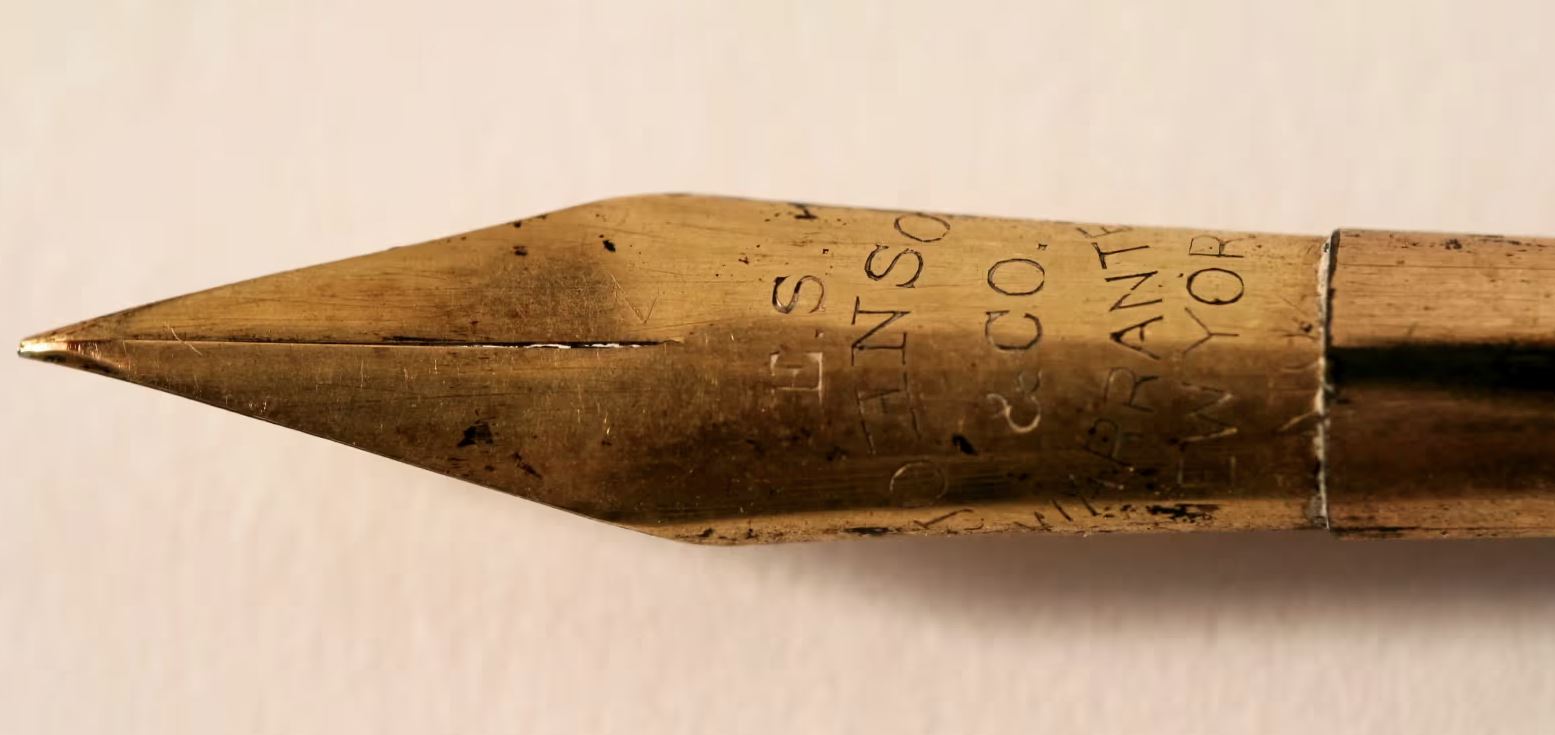
A fountain pen may seem simple at first glance, yet its mechanism conceals extraordinary precision. Ink must move from reservoir to nib at exactly the right rate: too fast and it bleeds, too slow and the line breaks. This balance relies on capillary action, the invisible force that draws liquid through narrow channels. Within the nib, two tines split delicately to regulate flow. Their alignment determines not only consistency but character. Even the smallest deviation changes how a pen feels. Some glide effortlessly, producing clean, wet lines. Others resist slightly, adding texture and feedback that makes writing feel alive.
The choice of nib shapes experience as profoundly as the choice of words. Fine points favor discipline, while broad nibs celebrate flourish. Flexible nibs, sensitive to pressure, translate emotion into movement. The reservoir, meanwhile, preserves the continuity of that movement. Whether filled through piston, cartridge, or eyedropper, it creates an unbroken connection between thought and ink. The design may appear mechanical, but its outcome is almost alchemical: the transformation of intention into form. In that transformation lies the magic that keeps writers and collectors devoted to these instruments long after faster tools have replaced them.
The Ink That Breathes
Every ink has its own temperament. Some saturate the page with dense pigment, while others shade lightly, revealing gradients where strokes overlap. The chemistry behind these variations is complex, involving dyes, surfactants, and water balance. Yet to enthusiasts, the difference feels almost emotional. A deep blue ink conveys calm introspection, while a crimson line carries urgency or passion. The choice of ink color becomes an extension of voice. Writers often experiment endlessly, seeking the hue that mirrors their inner rhythm. Ink is not static; it reacts to light, humidity, and paper texture, evolving as it dries. In this way, every page becomes alive, a collaboration between substance and environment.
Some inks shimmer with metallic particles, turning script into art. Others are formulated for permanence, resisting fading and water. Collectors treasure rare inks, mixing their own to capture unique tones. There is pleasure even in the ritual of filling, a moment of intimacy between writer and instrument. Watching the reservoir fill feels symbolic, as if replenishing creativity itself. The faint aroma of ink becomes memory. Long after the page dries, the scent lingers, connecting the writer to the moment of creation. It is this sensory depth, this quiet ritual, that sets fountain pens apart from every other tool of writing.
Paper as Companion
The pen cannot exist without its companion, the page. Paper determines not only how ink appears but how it behaves. Smooth paper invites fluid motion, while textured surfaces engage friction, revealing nuance in every line. The relationship between pen and paper is almost conversational. The nib speaks; the fiber responds. Too absorbent, and the ink spreads uncontrollably; too resistant, and the nib scratches in protest. True harmony arises when both elements respect each other. The right pairing transforms writing from act to performance, every word flowing with balance and grace.
Collectors and writers often develop deep loyalty to certain papers, from handmade cotton sheets to modern Japanese brands that treat each fiber like a note in a melody. Even notebooks become part of the art. Bound journals hold ink differently than loose sheets, their structure guiding rhythm. Paper, like pen and ink, becomes part of identity. Together they create continuity, a trinity of craft that transforms the ordinary into ritual. To write with intention is to respect this relationship. Each stroke acknowledges not just the hand but the materials that make expression tangible.
The Collector’s Pursuit
To collect fountain pens is to collect stories. Each pen carries the imprint of the time and culture that shaped it. A German piston filler from the 1950s speaks of postwar precision, while an Italian celluloid masterpiece reflects baroque indulgence. Some collectors chase rarity, others seek perfection of design. But beyond the aesthetic lies a deeper longing: connection to history. A pen once owned, used, or admired becomes a bridge across generations. The collector does not simply possess; they preserve. Each pen becomes part of a living archive of craftsmanship and creativity.
The pursuit often begins with a single pen that awakens fascination. From there, curiosity deepens into expertise. Collectors learn the language of nib widths, feed designs, and filling systems. They trade, restore, and discuss nuances with others who share the obsession. Online communities and pen shows transform private passion into shared culture. There is joy in discovery, but also reverence. Holding a century-old pen, still capable of writing, evokes gratitude. It stands as proof that quality endures and that care, not consumption, defines value. Collecting fountain pens, in this sense, becomes an act of resistance against disposability.
The Art of Repair and Renewal
Unlike modern pens designed to be discarded, fountain pens invite repair. Their construction encourages disassembly, adjustment, and restoration. To repair one is to collaborate with its maker across time. The restorer polishes metal, replaces sacs, adjusts nibs, and breathes new life into mechanisms that once lay dormant. Each act of restoration revives not only the object but the era it represents. The craft requires patience and precision, guided by both technical skill and empathy for the pen’s design. Restoration is preservation through care, proof that artistry can survive the erosion of time when tended with respect.
The philosophy behind repair transcends practicality. It embodies sustainability and reverence for craftsmanship. In an age of instant replacement, to repair is to honor continuity. Each polished nib and re-sealed reservoir becomes an act of gratitude toward those who valued beauty enough to build something meant to last. Many collectors learn basic repair techniques themselves, cultivating a bond with their instruments. Through this process, the pen ceases to be an object and becomes a companion. Its imperfections tell stories of endurance, echoing the very human desire to mend rather than discard.
The Modern Reawakening
In an era dominated by screens and instant communication, the fountain pen endures as quiet rebellion. Its revival among younger generations is not nostalgia but rediscovery. People crave authenticity and tactility in a digital world. Writing with a fountain pen slows time, forcing mindfulness. Each letter becomes intentional. The experience contrasts sharply with typing, which prioritizes speed over substance. The rise of journaling, calligraphy, and analog creativity has breathed new life into the art of writing by hand. Modern manufacturers have responded with renewed innovation, combining traditional aesthetics with contemporary materials and design.
Social media has also amplified this renaissance. Communities share ink swatches, handwriting samples, and restoration guides, transforming solitary practice into collective culture. Enthusiasts post videos of ink filling, nib flexing, and line shading, turning craftsmanship into performance art. The fountain pen, once viewed as an artifact of the past, has become a symbol of deliberate living. Its value lies not in prestige but in presence. To use it is to reclaim attention in a distracted age. Through it, writing returns to what it always was, a personal, expressive, and profoundly human act.
Where the Line Continues
To write with a fountain pen is to join a lineage that stretches across centuries of thought and artistry. Each stroke links the writer to those who came before, from poets to diplomats to dreamers. The ink that flows today carries echoes of every word ever written with similar grace. A fountain pen is not a relic but a reminder that permanence can coexist with fluidity. It asks the writer to slow down, to observe, to care. When the nib meets the page, the act becomes both intimate and infinite. The mark it leaves may fade, but the gesture remains timeless. In the end, ink remembers the hand, and through it, the hand remembers to feel.